How to Automate DAT
DAT automates the market side. The load board finds capacity, RateView Analytics prices the lane, LaneMakers surfaces carriers already searching it, and CarrierWatch checks authority and insurance. The work around a load, customer portals, rate confirmations, claims and credit, sits on other websites, which is where an agent like WebRun runs.
 Written by
Dimitri Vasilev
Logistics analyst
Written by
Dimitri Vasilev
Logistics analyst
 Reviewed by
Hannah Vogel
Finance operations
Reviewed by
Hannah Vogel
Finance operations
A load gets a price on DAT before it gets a truck
DAT Freight & Analytics runs the load board that North American truckload freight is bought and sold on. A broker posts a customer's load and goes looking for capacity, a carrier with an empty truck in Laredo searches for something heading the right way, and both read the same market to price the lane.
That makes it two things at once: a marketplace where a load and a truck find each other, and a price signal, because a lane pays whatever people are actually paying this week, and that number moves.
For a brokerage it is the first screen of the morning and the last of the evening. Loads to cover, trucks to call, lanes to price, carriers to check. The margin is set in the hour between the customer tendering a load and somebody agreeing to haul it, and DAT is where most of that hour goes.
Covering the load is the fast part of a broker's day
Ask a broker what takes the time and it is not finding trucks.
It is everything around the load. A carrier is booked, so somebody sends the rate confirmation and chases the signed copy. Somebody checks the insurance certificate is still live and the authority has not changed since this carrier last hauled. Somebody sets up a new carrier and collects a W-9, a signed agreement and a notice of assignment.
The customer end is worse, because none of it is on the board. A shipper tenders loads through their own portal, so somebody logs in each morning to see what arrived overnight. A new shipper wants terms, which means finding out whether they pay in thirty days or ninety. A detention claim goes into the customer's system and has to be chased until it is settled.
None of that is on the load board, and all of it decides whether the brokerage made money.
RateView prices the lane, it cannot price your customer
DAT covers the market side thoroughly, and a broker not using the data is guessing against people who are not.
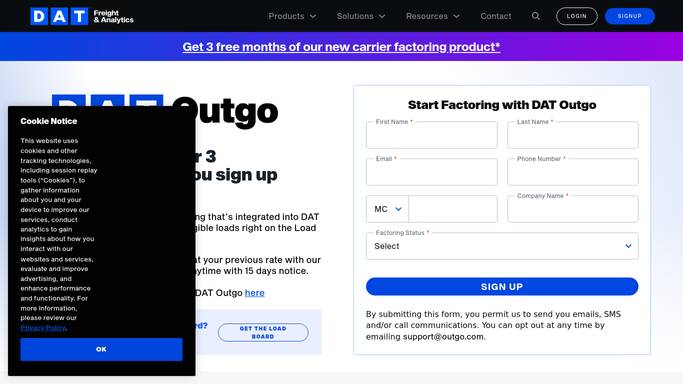
The DAT One load board reaches the North American network of loads and trucks, with searches, postings and alerts on the lanes you run. RateView Analytics, in DAT iQ, carries spot and contract rates by lane, so a quote rests on what freight is actually paying rather than last year's number. LaneMakers surfaces the carriers already searching your lanes, a better question than who happens to be posting a truck right now. DAT CarrierWatch handles vetting at the moment you look: authority, safety, insurance and certificates in one place.
Those are real answers, about the market and the counterparty.
The ceiling is that the market is not your business. Your customers tender loads in their own portals, on their own schedules. Your carriers' paperwork expires on dates held by their insurers and factoring companies. Your claims are settled in whichever system the shipper uses. Your exposure to a new customer sits on a credit site, and your margin sits in your accounting. Each of those is a login and a screen, and none appears on a load board.
A broker who watches customers as closely as lanes
Everything that happens around a load after booking depends on somebody remembering it. Those portals will open for anything holding the login.
Every shipper portal checked before the desk fills up, so loads tendered overnight are on one list at seven rather than found at eleven. Rate confirmations tracked until the signed copy comes back, with the carriers who have not returned one on a chase list. Insurance and authority rechecked on a cycle for the carriers you actually use, so the certificate lapsing in March is not discovered in May.
The money follows the same pattern. New shippers credit-checked before the first load rather than after the first slow payment. Detention and other extra charges chased in the customer's system until paid or refused. Factoring packets assembled with the rate confirmation, bill of lading and proof of delivery attached. Margin per load worked out from what was really billed and really paid, so a lane that looks strong on the board and loses money in practice shows up.
The split is clean. Reading portals and building lists can run unattended. Booking a carrier, sending a rate confirmation or agreeing a price commits the brokerage, so each is left for a person.
The same eight checks, run before anyone asks
Somebody in the office runs those checks every time, in the same order, on the same few websites. That is a description of work, not of judgement.
WebRun is an AI agent that works a real Chrome browser, signed in as you. It opens the shipper's portal, the carrier's certificate page or the credit site, reads what is there, and turns it into the list you wanted: tonight's tenders, this week's expiring insurance, the unpaid claims.
It runs on your schedule in your own private environment, and you can watch a run and stop it. Anything that commits the brokerage, a booking, a rate confirmation or a price, waits for approval.
The workflows below are already built, and each one names the sites it opens.
Questions people ask
Could it book a carrier or send a rate confirmation?
No. It gathers, compares and drafts, then stops. Booking a carrier and sending a rate confirmation commit the brokerage to a price and a truck, so both are prepared and left for a person to send.
We already pay for CarrierWatch. Where does this start?
Where a lookup ends. CarrierWatch answers the question at the moment you ask it. This covers the carriers you already use, on a cycle, plus the customer-side work that never appears on a load board at all.
Is this scraping the load board?
No. It works a browser signed in as you, at human pace, inside the account you already pay for, and most of what it is pointed at is your own customer and carrier portals rather than the board itself.
12 ready-made DAT workflows
Each one names the apps it touches and the exact steps it takes. Open one to read what it will do, then turn it on.


Want one of these running on your own DAT?
Show WebRun the process once and it will run it on schedule, in your own private browser environment.