How to Automate CGM APRIMA
CGM APRIMA already automates the practice's own side: replication keeps the chart usable offline, CGM AMBI drafts the note in the room, CGM CONNECTION sends patient reminders and CGM INDEX.AI files incoming faxes. The discharges, equipment orders and authorizations sit on other people's portals, and reading those is work for an agent like WebRun.
 Written by
Hannah Vogel
Finance operations
 Reviewed by
Tom Kessler
Field operations analyst
APRIMA follows the visit wherever the visit happens
Most of the people who use it every day still say Aprima. The product came to CompuGroup Medical with the 2020 acquisition of eMDs and is sold now as CGM APRIMA, an electronic health record with practice management alongside it, used across a wide spread of specialties.
A house-call practice is where the design shows. The provider is not in a clinic. They are in a bungalow living room with a cat on the sofa, doing a chronic care visit for a ninety-one-year-old whose daughter took the morning off work to be there. The chart has to open in that living room, the note has to be finished before the next address, and the mobile signal is whatever the street happens to have.
Everything the practice knows about that patient is inside APRIMA: the problem list, the medications, the last encounter, the advance directive, the balance and the claim.
Between house calls the chart waits on somebody else's system
The gap in a home-based practice is not documentation. It is everything that happened to the patient while nobody from the practice was in the room.
A patient went to the emergency department on Saturday night and the practice hears about it on Wednesday. The oxygen concentrator was ordered ten days ago and nobody can say whether the supplier has scheduled a delivery. A prior authorization for home-based imaging is sitting on a payer's website with a status nobody has looked at. The home health agency has a plan of care that needs signing and it lives in their portal, not yours. A hospice referral went out and the answer came back as a fax.
So a coordinator spends the morning on hold and in browser tabs, writing down what they learn, and the provider gets it in the car between the second address and the third, if the timing works.
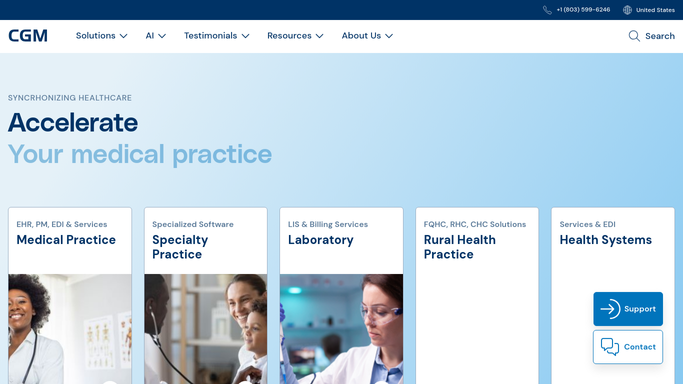
Replication keeps the chart working where the signal does not
CGM has built out the parts of this that sit inside the practice, and a group paying for the suite should have all of them running before adding anything else.
Anytime, Anywhere Replication matters most on the road: the chart works with or without a connection and syncs when it finds one, which is the difference between documenting in the living room and documenting from memory at nine at night. CGM AMBI listens to the encounter and drafts the note as it happens. CGM CONNECTION handles automated patient communication by text, email and phone, so reminders and recalls go out without anybody dialling. CGM INDEX.AI takes the incoming faxes and scans, which in home-based care is a substantial pile, and files them instead of leaving them for a person to sort. The interface adapts to how a given provider works, presenting findings around the symptoms and diagnoses they see most.
What all of it shares is that it works on what the practice holds. The answers a coordinator is chasing live on a hospital's system, a payer's site, an equipment supplier's order page or a home health agency's portal. Each of those opens for a person with their own login, and nothing on the practice's side reaches them.
The day's route arrives with its answers already attached
Picture tomorrow's route sheet with the outside facts already gathered against each name.
Hospital and emergency department activity checked each morning on the systems that hold it, so somebody discharged on Sunday gets a visit on Monday rather than at their next scheduled call. Durable medical equipment orders followed on the supplier's own page, so the bed, the concentrator and the wheelchair each have a delivery date or a reason they do not. Prior authorizations tracked on the payer's site until they turn, oldest first.
Home health plans of care and recertification dates read out of the agency portal and put in front of the provider who has to sign them. Specialty pharmacy fill status for the medication that keeps getting refused. Coverage rechecked against the coming week, since a plan that changed in January is otherwise discovered on a doorstep.
A house-call practice keeps one boundary exactly where a clinic would keep it, and being in somebody's living room does not move it. Gathering runs unattended. Anything that writes to a chart, changes an order or goes to a patient or a caregiver is prepared and left for a qualified person to review and send.
Nobody on the care team should be on hold at eight in the morning
The coordinator who knows this panel is the right person to decide what a discharge summary means. They are the wrong person to spend forty minutes establishing that it exists.
WebRun is an AI agent that works a real Chrome browser, signed in the way your staff are. It opens the payer site, the supplier's order page or the agency portal, reads what is on the screen, and hands back the answers attached to the names on tomorrow's route.
It runs on your schedule in your own private environment, sessions are not shared between workflows, and a run can be held to a named list of domains. It does not write to the chart. Each workflow below names the sites it opens.
Questions people ask
Can it write anything into the patient's chart?
No. It gathers and presents, and a qualified person acts. Anything that changes a clinical record, alters an order or reaches a patient or caregiver is prepared and left for review. A run can also be restricted to a named list of sites.
Our providers document in the home already. Where does this help?
After the visit rather than during it. Replication and ambient documentation cover the encounter itself. This covers the facts that arrived while nobody from the practice was in the room, which is where a home-based panel loses time.
Is it safe to run against a payer portal with our login?
It runs in your own private environment on a schedule you set, sessions are not shared between workflows, and a workflow can be limited to an explicit list of domains, so it reaches the sites you listed and cannot wander somewhere else with a live session.
12 ready-made CGM APRIMA workflows
Each one names the apps it touches and the exact steps it takes. Open one to read what it will do, then turn it on.


Want one of these running on your own CGM APRIMA?
Show WebRun the process once and it will run it on schedule, in your own private browser environment.