How to Automate RLDatix
RLDatix already holds the event, the investigation, the register and the huddle in one platform. Automating the rest means having something read those queues on a schedule and carry what is overdue to the owner's phone or inbox, with names and dates attached. WebRun does that carrying.
 Written by
Priya Raghavan
Solutions lead
Written by
Priya Raghavan
Solutions lead
 Reviewed by
Marta Ellison
Automation strategist
Reviewed by
Marta Ellison
Automation strategist
Filing the incident report is the fastest part of it
RLDatix makes the governance, risk and compliance software a hospital uses to record what went wrong and to prove what it did about it. Its RLD360 platform is modular, and the safety side of it covers Event Reporting, Root Cause Analysis, Feedback, Claims, Risk Register and Safety Huddles, with policy management, audits and standards, and credentialing sitting alongside.
The people inside it are risk managers, patient safety officers, quality directors and unit managers, plus, briefly, every clinician who has ever filed a report.
That last group matters most. A nurse who watched a near miss at the end of a twelve-hour shift files an event, and that record becomes the hospital's memory of the thing. Whether it turns into an improvement or into a filing depends entirely on what happens over the following six weeks, which is a stretch of time the nurse who filed it never sees.
The follow-up outlives everybody's attention
The queue is never the problem. The queue after the queue is.
An event arrives and something has to happen to it inside a window: triage, categorisation, an owner, an investigation opened, actions written, actions closed. A serious or high harm event starts a different clock again, with mandatory follow-up steps counted in hours rather than days. A patient complaint has an acknowledgement deadline. A risk register item has a review date that arrives whether or not anybody is thinking about it.
So a risk manager spends a large part of the week reading the same screens and writing the same emails. Who owns this one. Is it overdue. Has anybody touched the corrective actions from March. Which register items come up for review in the next fortnight. Which unit's near misses have started clustering around the same medication.
And each morning somebody types a safety huddle brief out of a system that already holds every fact in it.
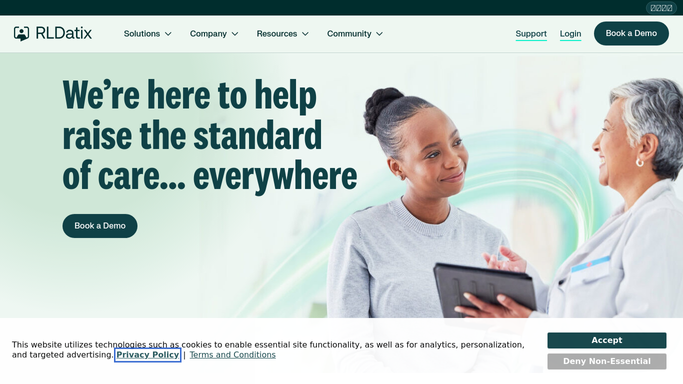
RLD360 keeps the event, the investigation and the risk in one place
To be fair to the platform, this is precisely the work it was built for.
Event Reporting automates notifications, can initiate a root cause analysis and can activate a response team. Root Cause Analysis carries structured tools, five whys and process mapping among them, for getting past the first explanation. The Risk Register holds risks with their owners and their review dates. Safety Huddles gives teams a structured place to flag issues, assign follow-ups and track trends, with a unified view pulling huddles and rounding together. Feedback and Claims sit on the same platform, so complaints, incidents, near misses and claims can be read as one picture instead of four.
The platform genuinely holds all of it. That is not where the ceiling is.
The ceiling is that the owners of those actions do not work in RLDatix. They are a ward manager on a late shift, a consultant between clinics, a pharmacy lead who signs in twice a month. The reminder that works is the one arriving where they already are, and the escalation that works is the one that reaches a phone. Neither is something a governance platform reaches out and does.
The overdue list can go and find its own owners
Every clock in patient safety starts with a record somebody filed and then stopped watching.
Events tagged serious or high harm read as they are filed, with the on-call safety leader texted straight away and the detail posted to the leadership channel, rather than the tag being noticed on Monday. The mandatory follow-up steps after a sentinel event tracked against the seventy-two hour window, each owner nudged where they read messages, and a running status posted until every step is done.
Open corrective action items approaching their due date emailed to whoever owns them, with a current list of what is still outstanding kept for the safety committee. Risk register items nearing review flagged a fortnight ahead rather than on the day. Investigations sitting past their target date collected into one overdue list with the owner and the age beside each. Near-miss and medication error patterns rolled up, so a cluster on one unit shows itself.
Reading, comparing and alerting run unattended. Closing an action, signing off a corrective action, editing an event record or contacting a patient or a family is drafted and left for the accountable person, because accountability is the whole product here.
The chasing comes off the safety team's desk
A risk manager's value is in the judgement: what this event actually means, and what would stop the next one. Most of the week goes on finding out whether anybody has done anything.
WebRun is an AI agent that works a real Chrome browser, signed in the way your risk team is. It opens RLDatix, reads the event queue, the action list and the register, and delivers what is overdue into Slack, Outlook or a text message, with names and dates attached.
It runs on your schedule inside your own private environment, sessions are not shared between tools, and a workflow can be restricted to a named list of domains. You can watch a run and stop it.
The workflows below are already built, and each one names what it opens.
Questions people ask
Will it close an action or sign anything off?
No. Closing an action, signing off a corrective action and editing an event record all stay with the named owner. The agent reports what is open, what is overdue and who holds it, which is the part that currently eats a risk manager's week.
Can it text somebody at two in the morning about a serious event?
Yes, on the rules you set. An event tagged serious or high harm can go straight to the on-call safety leader as a text, with the detail posted for leadership, instead of waiting to be noticed when somebody opens the queue.
Reporters are promised the system is confidential. Does that still hold?
It sees exactly what the person whose login it uses already sees, and nothing more. Sessions stay in your own private environment and are not shared with other tools, and a workflow can be restricted to a named list of domains, so nothing leaves the places you allowed.
12 ready-made RLDatix workflows
Each one names the apps it touches and the exact steps it takes. Open one to read what it will do, then turn it on.


Want one of these running on your own RLDatix?
Show WebRun the process once and it will run it on schedule, in your own private browser environment.