How to Automate iUNU
iUNU automates the looking. LUNA AI cameras track every plant continuously, turning growth rate and spacing into yield forecasts, and image-based alerts flag pest and disease pressure each morning. The retailer's vendor portal, the carrier's tracking page and the utility dashboard sit outside the glass, which is where an agent like WebRun works.
 Written by
Yara Haddad
Data operations
Written by
Yara Haddad
Data operations
 Reviewed by
Nora Whitfield
Editorial lead
Reviewed by
Nora Whitfield
Editorial lead
The cameras see the crop more often than the grower does
A greenhouse is too big to walk properly. That is the plain fact iUNU was built on. A grower with several hectares under glass and a crew stretched across it sees a sample of the crop, on whatever route they take, at whatever time the walk fits.
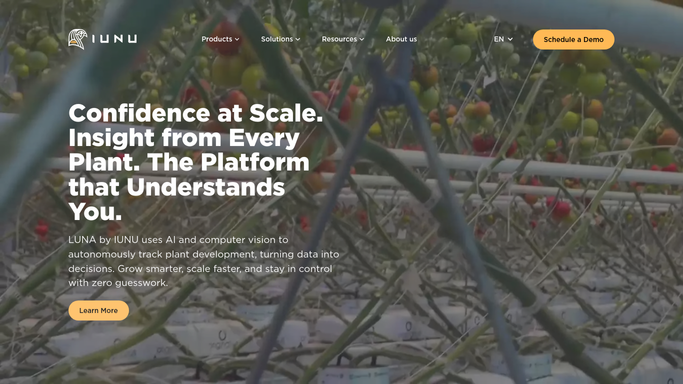
iUNU has been at this from Seattle since 2013. Cameras move through the house and watch the plants continuously, and LUNA AI turns what they see into numbers: germination counts, daily growth rate, spacing density, crop health, plant by plant, from propagation through to harvest. Around it sit LUNA Inscribe for crop registration on a phone, LUNA Connect for tying into the systems already in the building, LUNA Advisor, and GrowerGPT for the questions a grower would otherwise ring a consultant about.
The people running it grow tomatoes, cucumbers and peppers, berries, leafy greens and ornamentals. What they get is a crop that reports on itself, without anybody touching a plant.
The forecast is right and the buyer still calls to ask
Knowing what the crop will do is only half of the week.
The other half is the order desk. Committed volume sits on the retailer's vendor portal, in their format, updated whenever they get to it. So somebody exports the forecast, opens the portal, and puts the two side by side in a spreadsheet to see whether next week is short or long. Then the same person opens the young plant supplier's availability list to see whether the variety meant to fill the gap is shippable, and books the truck.
Afterwards it runs the other way. Loads leave and somebody follows them on the carrier's tracking page. The energy bill is one of the largest lines in the business and lives on the utility's dashboard, where nobody looks until it arrives. The audit portal wants documents uploaded before an unannounced visit, and nobody is sure which have gone stale. None of that is growing. All of it is a person with a browser and a list of logins.
LUNA AI watches the crop, not the paperwork
What the platform does inside the house it does better than a person can, and that deserves saying before anything else.
Yield forecasting works off growth velocity, spacing data and the environment together, so a forecast of both volume and readiness arrives in time to hit a packing window rather than after it closes. Autonomous issue detection is the one growers talk about: the vision system picks up early signs of pest and disease pressure and sends image-based alerts, with a summary of what it found landing in the inbox every morning. LUNA Inscribe puts crop registration on a phone in the aisle, and LUNA Connect exists to tie the platform to the other systems in the building.
So the crop is covered. What is not covered is nearly everything the crop is grown for. LUNA Connect can reach a climate computer or an ERP that offers a connection. It cannot reach the retailer's vendor portal, because that portal offers nothing to connect to. It cannot open the carrier's tracking page, or the utility dashboard, or the audit site. Those were never in scope, and no amount of camera resolution gets to them.
A yield forecast that arrives with the orders it has to cover
Work starts with what the cameras see, so the useful move is carrying that outward to the places it has to land.
Picture the weekly forecast leaving with the retailer's committed volume already beside it, read straight off the vendor portal that morning, so a short week is visible as a difference rather than as two documents somebody has to reconcile. Picture the harvest-readiness figure set against the delivery appointments actually booked, so a crop coming ready three days early is a booking problem somebody sees on Monday.
Picture the morning issue alert arriving with the room, the bench and the crop cycle already named, and the last few scouting notes for that room attached, so the IPM lead starts from a history rather than a photograph. Or the young plant supplier's availability list read as it updates, against the propagation batches the record says are running short. Or the energy dashboard checked each morning against the same day last week, so an anomaly in a heating or lighting zone is caught while it is still a question.
Somebody has to open the order desk anyway
That work does not need intelligence. It needs somebody to sign in to six sites, read a table on each, and write down what changed.
WebRun does exactly that. It drives a real browser as you, on your schedule, across the retailer portal, the carrier, the supplier's availability page and the utility dashboard, and returns what it found beside the numbers LUNA already produces. Nothing for the retailer to build, no export button required.
Gathering runs on its own. Anything that commits volume to a buyer, confirms a delivery or messages a customer is drafted and left for a person, because a promise on volume is a promise the greenhouse then has to keep. The cards below are the jobs greenhouse teams usually turn on first.
Questions people ask
Will it commit volume to a buyer based on the LUNA forecast?
No. It reads the forecast, reads the buyer's portal and puts the two together, but committing volume is drafted and left for a person. A forecast is a probability and an order is a promise, and the greenhouse is the one that has to keep it.
We already run LUNA Connect. What is left for this to do?
LUNA Connect ties the platform to systems that offer a connection, such as a climate computer or an ERP. Most of the sites around a greenhouse offer none: a retailer's vendor portal, a carrier's tracking page, a utility dashboard. Those get read in a browser instead.
Does it need access to the camera images or the LUNA account?
Only the access you already have, and only where a workflow needs it. Many of these run entirely outside iUNU, on the portals around it. Where one does read LUNA, it signs in as you would and reads the same screens, taking nothing extra.
12 ready-made iUNU workflows
Each one names the apps it touches and the exact steps it takes. Open one to read what it will do, then turn it on.


Want one of these running on your own iUNU?
Show WebRun the process once and it will run it on schedule, in your own private browser environment.