How to Automate DSN Software
DSN Software automates a specialty dental practice through DSN Atlas. The Referral Hub queues incoming referrals with status tracking, Cloud Imaging serves 2D and 3D scans on any device, Ask Atlas queries live patient data by voice, and confirmations send themselves. The dental and medical payer portals stay outside, which is where WebRun works.
 Written by
Tom Kessler
Field operations analyst
Written by
Tom Kessler
Field operations analyst
 Reviewed by
Aiko Tanabe
Product researcher
Reviewed by
Aiko Tanabe
Product researcher
An oral surgery practice runs on other dentists' patients
DSN Software makes cloud practice management and clinical software for dental specialists: oral and maxillofacial surgeons first, then periodontists, endodontists, general dentistry and multi-specialty groups. Its current platform is DSN Atlas, which runs in a browser with no servers in the building.
A specialty dental practice is a referral business in a way a general dental office is not. Almost nobody walks in. A general dentist finds an impacted third molar, a failing tooth or a lesion, and sends the patient across town with a note and an image. The whole supply of new patients is other practices' goodwill, which makes the referring office the customer, the marketing channel and the source of the clinical record all at once.
The case does not end when the patient leaves, either. It ends when the referring dentist gets an answer, and whether they send the next one depends on how long that took.
One case, two insurers, two portals
Then there is the billing, which is genuinely peculiar to this specialty.
A dental plan and a medical plan can both be in play for the same procedure. Impacted teeth, trauma, biopsies, pathology and some implant work sit on the line between them, and which one pays depends on the diagnosis, the plan and often the reviewer. So the coordinator is on two portals rather than one, and they behave nothing alike. The dental side has an annual maximum and a remaining benefit that only shows on the payer's own site. The medical side wants a predetermination, a narrative and sometimes a scan attached.
Around that sits everything else. The panoramic image still in the referring office's system. The pathology report waiting in an outside laboratory's portal. Implant and graft components ordered on a manufacturer's site. A hospital case that needs an authorisation before an operating room can be booked.
Every one of those is a different login and a different person on the other end waiting to be chased.
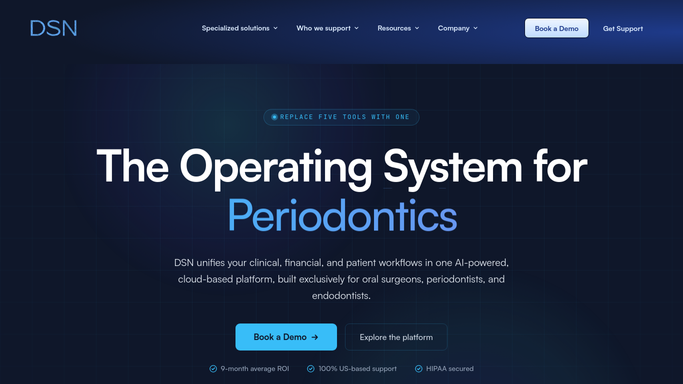
Atlas already handles the referral, the scan and the confirmation
DSN has built hard for this, and a practice running Atlas properly has covered more ground than most of its category.
The Referral Hub is a central queue for incoming referrals with status tracking and filters, and each one opens a patient snapshot with appointments, a timeline and quick actions, so a coordinator can call, text or email straight from the referral record. Cloud Imaging delivers 2D and 3D CBCT scans in seconds on any web-enabled device with nothing to install, and the AI imaging tools do nerve detection, implant planning and 3D measurement. Ask Atlas is voice and text over live patient data: pull a report, open a chart or ask a question mid-procedure without stopping to type. Appointment confirmations go out automatically, patients register and complete intake online, prescriptions send natively from a phone, and an RCM solution, payments and a patient portal sit underneath.
All of it runs on records inside Atlas. The referring dentist's own software is not inside Atlas.
Neither is the dental plan's benefits page, the medical payer's authorisation queue, the pathology laboratory's portal or the implant manufacturer's ordering site.
Remaining benefits and pathology results can arrive before the consult
The coordinator already has every one of those logins. What the practice does not have is the time to work through them all before each patient arrives.
Remaining annual maximum and eligibility checked on the dental plan's own site for every consult booked next week, so the coordinator can quote a number the patient can act on rather than promising to call back. Medical predetermination status followed on the payer's portal every few days, so an authorisation that stalled in week one is chased in week two instead of found on the morning of surgery.
Pathology reports collected from the laboratory's portal and filed against the right chart, so a result is read before the patient rings to ask. Implant and graft orders tracked on the manufacturer's site, because a backordered component is a rescheduled operation. Referring offices closed out: which of last month's referrals got a report back and which did not, listed by practice, which is the retention question every specialty office means to ask and never does.
The records stay supervised. Reading and comparing run unattended. Anything that writes to a chart, submits a claim or reaches a patient or a referring dentist is drafted and waits for a person to send it.
Chair time is the only thing the practice actually sells
Somebody is opening all of those portals today, usually the treatment coordinator, usually between phone calls, and usually not all of them.
WebRun is an AI agent that works a real Chrome browser, signed in as your staff are. It opens the dental plan, the medical payer, the pathology laboratory or the supplier site, reads what is there, and brings back a list with the exceptions on top.
It runs on your schedule in your own private environment, sessions are not shared between tools, and a workflow can be locked to a named list of domains. You can watch a run and stop it at any point.
The workflows below are built already, and each one names what it opens.
Questions people ask
Will it submit a claim or a predetermination on its own?
No. Anything that submits, writes to a chart or reaches a referring office is prepared and left for a person. The unattended part is the checking: eligibility, benefit maximums, authorisation status and order tracking.
Our dental and medical portals are nothing alike. Does that matter?
No. It reads each site the way your coordinator does, one screen at a time, so two payers with nothing in common are simply two stops in the same run. Most of them publish no API, which is exactly why the browser is the route.
Can it pull a pathology report from an outside laboratory?
Yes, and it is a common reason to use it. It signs into the laboratory's portal with your own credentials, reads the report and brings it back attached to the right patient, because a site like that offers no other way in.
12 ready-made DSN Software workflows
Each one names the apps it touches and the exact steps it takes. Open one to read what it will do, then turn it on.

Want one of these running on your own DSN Software?
Show WebRun the process once and it will run it on schedule, in your own private browser environment.