How to Automate Captira
Captira automates the agency side well. Text reminders go to defendants and indemnitors for court dates and payments, check-ins capture location and a photo, payment plans run themselves, and Defendant Watch flags a re-arrest. Watching the county's own docket for a reset date is the part still done by hand.
 Written by
Grace Okafor
Healthcare operations
Written by
Grace Okafor
Healthcare operations
 Reviewed by
Tom Kessler
Field operations analyst
Reviewed by
Tom Kessler
Field operations analyst
A bail bond keeps the agency liable until the case is over
Captira is management software for bail bond agencies, and the business it holds is unlike most of what runs on a laptop. Writing a bond is not selling a service and moving on. It is promising a court that a named person will appear, and putting up the money if they do not.
So the file on each bond is a liability that stays open, sometimes for a year. The defendant, the indemnitor who signed and put up collateral, the power number, the charges, the court, the next date, the premium still owed.
The agencies running it are small. A handful of agents, often one family, covering a county or two, on call at two in the morning because that is when people get arrested.
There is no back office. The person who wrote the bond at midnight is the one doing the paperwork at nine.
Between bonds, the job is reading other people's websites
Court dates move. A case is continued, a hearing is reset, a plea date is added, and the notice goes to the defendant and the attorney.
The agency, which is the party actually carrying the money, finds out by looking. So somebody opens the county's case search, types in a name, reads what changed, then does it again for the next hundred open bonds.
The rest is chasing. Premium payments that stopped after the third instalment. An indemnitor who still has not sent the document they promised at signing. A defendant who has missed two check-ins and whose phone now rings out. A forfeiture notice with a deadline counted in days, where the gap between remembering and forgetting is the full face value of the bond.
None of that takes skill. All of it takes somebody at a screen, on a day when they were also out writing bonds.
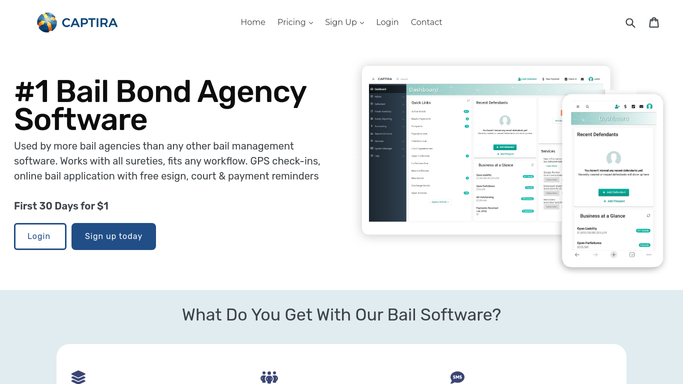
Captira automates the reminders it has a phone number for
Captira automates a good deal of this, and an agency should be running all of it before adding anything on top.
Automated text reminders go to defendants and indemnitors for court dates, scheduled check-ins and payments. Automated check-ins send a link by SMS that captures the defendant's location and a photo, with an alert if it comes from outside a geo-fence you have drawn. Automated payment plans keep the premium instalments moving without somebody ringing every week. Defendant Watch tells you if one of your defendants is arrested again anywhere in the country, which is usually the first sign a bond is about to become a problem.
That is a serious set of tools, and the arrest alert alone justifies the software.
Every one of them starts from something Captira already holds: a phone number, a payment schedule, a check-in rule, a name on a watch list. The court's own record is not something Captira holds. Neither is the county case search, the clerk's docket where a continuance first appears, the jail roster three counties over, or the forfeiture notice posted as a PDF on a court portal. Those publish to whoever signs in and looks.
A court date changes and nobody tells the bondsman
The court's record and the agency's board hold two versions of the same date, and they can be compared every morning.
Every open bond checked against the court's own record before the office opens, so a date reset on Thursday afternoon is on the board on Friday and the reminder carries the new date. That single failure, a text confirming a hearing that has already moved, is how somebody ends up at the courthouse on the wrong day.
A forfeiture notice picked up when it posts, with the days remaining counted against the deadline, because the exposure on that bond turns on a date somebody has to notice. The jail roster read for names already on your books, so a re-arrest is known before the surety asks. Dispositions watched, so a closed case becomes a bond that can be exonerated and a file finally shut.
The boundary is set by the work itself, not by preference. Reading a public docket and comparing it with the file can run unattended all night. Anything reaching a defendant, an indemnitor, a court or a surety goes in front of an agent first. A person's liberty and somebody's house are at the other end.
Checking a docket is clerical, calling a defendant is not
Reading a county case search and writing down what changed is clerical work with expensive consequences behind it. The reading can be handed over. The deciding cannot.
WebRun is an AI agent that works a real Chrome browser, signed in as your agency is. It opens the county case search, the jail roster and the court's docket, reads what each one shows, and brings back a list: what moved, what posted, who was booked again, which deadline is closest.
It runs on your schedule in your own private environment, and a workflow can be locked to a named list of sites. Nothing goes to a defendant, an indemnitor or a court without an agent reading it first.
The workflows below are already built, and each one names what it opens.
Questions people ask
Will it text our defendants on its own?
No. Messages to defendants and indemnitors are drafted and left for an agent to send. Captira's own reminders are the right tool for the scheduled texts. What this adds is checking the court's record first, so the date in the message is the one currently set.
Can it file anything with a court or report to a surety?
No. It reads: dockets, case searches, jail rosters and forfeiture notices, then reports what changed and what is due. Filing, posting and anything sent to a surety carries a signature, and that stays with a licensed person at the agency.
Is it safe to point this at county court websites?
It opens the same pages an agent would open, signed in as your agency where a login is needed. Sessions stay in your own private environment, a workflow can be locked to a named list of sites, and you can watch a run and stop it. It reads what is published and submits nothing.
13 ready-made Captira workflows
Each one names the apps it touches and the exact steps it takes. Open one to read what it will do, then turn it on.

Want one of these running on your own Captira?
Show WebRun the process once and it will run it on schedule, in your own private browser environment.