How to Automate Vista
Vista runs the cinema and reports on it. Head Office covers a whole circuit, Film Manager handles the programme, and Loyalty, Subscriptions and Vouchers cover the guest side. Review pages, distributor extranets and ticket aggregators sit outside every one of those, and an agent like WebRun is what brings them back.
 Written by
Sofia Marchetti
Marketing operations
Written by
Sofia Marchetti
Marketing operations
 Reviewed by
Rosa Lindqvist
Operations editor
Reviewed by
Rosa Lindqvist
Operations editor
A cinema runs on the session list and the till
Vista is cinema management software, built by Vista Group in New Zealand and used by exhibitors from a single independent to circuits running hundreds of screens. It comes in two generations, the long-established Vista Classic and the newer Vista Cloud, and to everybody who works in a cinema it is just Vista.
What it holds is the whole operation. The session list and the seating for every screen. Point of Sale on the counter and the Cash Desk behind it. Food and Beverage, which in a modern cinema is a large part of the margin. Loyalty and Subscriptions, Vouchers and Gift Cards, the Kiosk in the lobby and the app in the customer's hand, and Head Office sitting over every site at once.
For a circuit it is not one system among several. It is the business.
Every morning starts by rekeying yesterday
Cinema admin is a morning ritual, and it is mostly copying.
Somebody pulls yesterday's admissions and takings by title and screen and puts them into the number head office reads. Somebody reconciles the day's cash and card against the accounting system. Somebody opens Google and TripAdvisor to see what guests said about the broken seat in screen four, and answers the ones that need answering.
Then the distributor side, which is where a programmer's week actually goes. Confirming hire terms for films booked in a fortnight, on the distributor's own extranet or over email. Reporting box office back to each distributor in whatever format that distributor wants. Checking what a third-party ticket aggregator sold that has not appeared anywhere internal yet.
And the housekeeping. Memberships expiring this month. Gift card balances that are a real liability on the accounts. A session at eleven tomorrow with nine seats sold that somebody should look at today, not in next week's report.
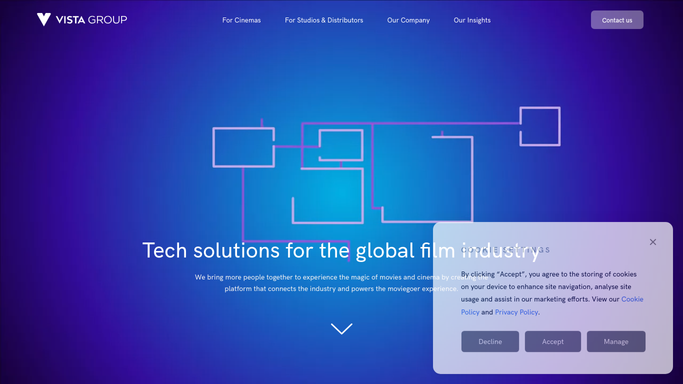
Head Office reaches every screen in the circuit
Vista is a deep system and most of that list has a module for it, so a circuit should be using what it already owns before adding anything.
Head Office manages operations across every site from one place, so a programme change or a price is not made twenty times. Film Manager runs the film side and the scheduling behind it. Cinema Intelligence sits over the numbers, and Custom Reports covers the ones a particular finance team wants. Loyalty, Subscriptions, and Vouchers and Gift Cards run the guest relationship, while Connect, the API and transaction engine, is what the web, mobile and kiosk channels transact through. Group Sales covers block bookings and the Call Centre takes the phone orders.
That is a serious amount of ground, and it is covered well.
What all of it has in common is that it acts on transactions that happened in Vista, on screens Vista controls, for guests who bought through a Vista channel. A distributor's extranet is not one of those. Neither is a review page, an aggregator's back office, or the rival multiplex's listings.
The distributor's extranet can reach the morning digest
Those sites publish on their own clocks and wait to be visited. The visiting can happen before anyone unlocks the doors.
Yesterday's admissions by title and screen, read out of Vista and posted before the first shift, with sessions that came in under target already flagged. New reviews on Google and TripAdvisor gathered against the site and the day they refer to, so a run of complaints about one screen is visible as a pattern rather than three separate annoyances. Hire terms for the next fortnight checked against what each distributor has actually confirmed, with the unconfirmed titles listed for the booker.
The quieter ones are worth as much. Gift card and voucher liability totalled for the accounts, with balances approaching expiry separated out. Memberships lapsing in the next fortnight listed before they lapse. Concession stock checked against the reorder level so the duty manager hears about it in the morning and not at the interval. Competitor showtimes for the same titles in the same town read off their own listings, so a programming call is made against what is actually on nearby screens.
The judgement stays where it is. What goes to a guest, a member or a distributor gets read by a person first.
The duty manager still approves what a guest reads
A cinema is a hospitality business, and the difference between a good reply to a bad review and a careless one is most of the reason for replying at all. The collecting can be handed over. The wording should not be.
WebRun is an AI agent that works a real Chrome browser, signed in as you. It opens Vista alongside the review pages, the distributor's extranet, the aggregator's back office or the accounting system, reads what each one shows, and brings back the digest: yesterday's numbers, the sessions under target, the reviews that need an answer, the terms nobody has confirmed.
It runs on your schedule, limited to the sites you allow. Messages to guests, members and distributors are drafted and left for a manager to send.
The workflows below are already built, and each one names what it opens.
Questions people ask
Who signs off the reply to an unhappy guest?
A manager does, always. It finds the review, matches it to the site and the session, and drafts a reply in your voice, then leaves it. Posting is a person's call, because a careless public reply costs more than the silence would have.
We already have Cinema Intelligence and Custom Reports. Why add anything?
Those report on what Vista knows. The distributor's extranet, a review page and an aggregator's back office belong to other companies, so nothing inside Vista can open them. That is the gap, and it is where the morning copying actually goes.
Is it safe to give it access to our box office system?
It sees what the person signing in sees, nothing more, and a run can be locked to a named list of sites. Sessions stay in your own private environment. You choose which screens it opens, and you can watch a run and stop it partway.
12 ready-made Vista workflows
Each one names the apps it touches and the exact steps it takes. Open one to read what it will do, then turn it on.



Want one of these running on your own Vista?
Show WebRun the process once and it will run it on schedule, in your own private browser environment.