How to Automate Like Sew
Like Sew covers the shop itself: fabric tracked by bolt, cut, colour and collection in fractional yards, precuts and kits with their components, class registration with text reminders, and marketing built in. Ship months, backorders and dealer stock live on the mills' own sites, which is the round an agent like WebRun makes.
 Written by
Aiko Tanabe
Product researcher
Written by
Aiko Tanabe
Product researcher
 Reviewed by
Nora Whitfield
Editorial lead
Reviewed by
Nora Whitfield
Editorial lead
A quilt shop's stock file is measured in inches
Like Sew runs the counter of a quilt shop, and the counting is the hard part. Nothing in a fabric store is a unit. A bolt arrives with fifteen yards on it and leaves in half-yards, fat quarters and the awkward two and three-eighths a border needs, so the figure changes every time somebody puts scissors to it. Like Sew tracks fabric by bolt, cut, colour and collection, which is four levels of the same thing, and it holds precuts and kits with their components tracked, so a bundle made from six bolts takes six bolts down when it sells.
The same records run the shop's website, so a bolt sold on Saturday is gone from both. On top of that sit the classes, which for a lot of shops are the reason anybody comes in at all: a roster, a supply list, a teacher and a Saturday. Owner, one full-timer and three people who quilt. That is who is using it.
Sourcing one colourway can take an afternoon
A quilt shop spends much of its week promising fabric it does not have. A customer wants eight more yards of a backing bought in spring, in that exact colourway, because the quilt is half finished and nothing else will do. The collection is eighteen months old. So the afternoon goes on the mill's dealer site, then the two distributors who might still have it, then a shop three states away that lists its stock online.
Meanwhile the ordinary chasing stacks up behind it. A collection promised for March, whose ship month quietly moved to May, which matters because a class was built around it. Half a notions order arrived and the rest is backordered with no date on it. Next month's block of the month fabric needs confirming before the members are billed. Every one of those answers sits on somebody else's website, behind a dealer login.
Like Sew counts the bolt, not the mill's warehouse
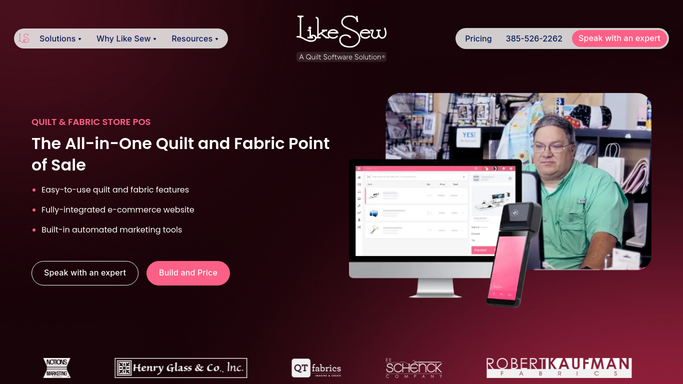
Inside the shop Like Sew does the specialist work properly, and a shop using half of it has the good half switched off. Inventory management tracks fabric by bolt, cut, colour and collection in fractional yards, which general retail software simply cannot do. Precuts and kits bundle fabrics with their components tracked, so the stock maths stays right when a kit sells. Integrated vendor catalogues and product data autofill mean a new line does not get typed in by hand, colourway by colourway. Class scheduling and online class registration take the roster and the payment and send text reminders. The built-in marketing runs email, texts, loyalty rewards and review requests, the reporting covers inventory turn, top sellers and top customers, and there are assistants for jobs like writing product descriptions and receiving invoices.
All of it is good, and all of it acts on what is already inside Like Sew or on a vendor catalogue it has already integrated. The mill's dealer site is a different animal. So is the distributor's ordering portal, the backorder page with the date on it, and the shop in another state still holding three bolts of the colourway you need.
A collection's ship month can be known before the class is booked
A shop that knows a collection's real ship month books its classes differently. Every open purchase order checked on the distributor's own site each week, so a line that quietly slipped to backorder shows up weeks before the class it was bought for. Ship months for the collections you have already committed to, gathered from each mill into one calendar, so a class is scheduled against a date somebody confirmed. The exact colourway a customer is asking for searched across the dealer sites and the shops that publish their stock, so the answer at the cutting table is yes or no rather than let me look into it.
Next month's block of the month fabric confirmed as available before the members are billed for it, which is the difference between a programme and an apology. Notions backorders followed until they carry a date. Class supply lists checked against what is on the shelf and what can arrive before the Saturday, so nobody turns up to a class short of thread. No mill has to publish an API for any of it, and no developer has to be hired.
The cutting table stays busy while the checking happens
Choosing which collection to bring in is why people drive past two other shops to get here. That taste is not automatable and should not be. The checking underneath it is.
WebRun is an AI agent that works a real Chrome browser, signed in as you. It opens a mill's dealer site, a distributor's ordering portal or a backorder page, reads what is on the screen, and brings the answer back next to the bolts, kits and class rosters in Like Sew. Runs go on a schedule you set, inside your own private environment, and you can watch one and stop it. Placing an order, changing a price or emailing a class list is drafted and waits for a person. The workflows below say which sites each one opens.
Questions people ask
Do students get messaged before we see the text?
No. Anything addressed to a customer, including class reminders, waitlist offers and block of the month notices, is written and left in your drafts. A person decides whether it goes. The unattended part is the reading: dealer sites, backorder pages and ship months.
Can it sign in to a fabric distributor's dealer site?
Yes, if you can. The agent drives a real Chrome browser using your own dealer credentials, so any site a member of staff can open and read is a site it can open and read. That covers ordering portals and backorder pages with no export button and no integration.
Vendor sites get redesigned. Does the run just break?
A redesign is handled the way a person handles it: the agent reads the page as it is rendered rather than following fixed coordinates, so a moved button or a renamed column usually just works. When a page changes past recognition the run reports that it could not find the figure instead of guessing at one.
10 ready-made Like Sew workflows
Each one names the apps it touches and the exact steps it takes. Open one to read what it will do, then turn it on.

Want one of these running on your own Like Sew?
Show WebRun the process once and it will run it on schedule, in your own private browser environment.