How to Automate Clinisys
Clinisys automates the laboratory internally. Rules based decision support and auto verification release routine results without a technologist, instrument integration starts tests as containers are received, and reporting interfaces file reportable conditions with public health. Proficiency schemes, assessor portals and regulator sites stay outside all of it, and an agent such as WebRun reads those.
 Written by
Tom Kessler
Field operations analyst
Written by
Tom Kessler
Field operations analyst
 Reviewed by
Dimitri Vasilev
Logistics analyst
Reviewed by
Dimitri Vasilev
Logistics analyst
Clinisys runs the hospital lab and the water lab on the same platform
Clinisys makes laboratory information systems and laboratory information management systems, which in most companies would be two products and here is one. The Clinisys Laboratory Solution is configurable for sample-centric and patient-centric workflows, with content packages for clinical pathology, anatomic pathology, genomics and toxicology alongside water quality, environmental, food and beverage, crop sciences and public health.
Older names are still in the estate and still supported: Clinisys Orchard Harvest and Orchard Enterprise, PowerPath and CoPathPlus for pathology, GLIMS, Atlas, and WorldCare for disease surveillance. Ask a laboratory manager what they run and you will usually get one of those.
The shape of the work barely changes across any of it. Something arrives with a label and a request. It gets logged in, tested, checked and released, and a result goes back to whoever asked, whether that is a doctor waiting on a potassium or a utility waiting on a coliform count.
Every lab answers to a body that runs its own website
A laboratory is not only judged on its own results. It is judged on samples it did not choose, sent by an outside scheme, on a calendar it does not set.
So somebody in the lab is always working somebody else's site. Proficiency panels arrive for each analyte and each method, get run blind, and the graded report comes back on the provider's portal weeks later, where a person has to go and look. The assessing body wants evidence uploaded before a visit, and the list of what is still outstanding lives on their site, not in the LIS. A regulator wants results filed in its own format on its own system by a date. An instrument goes down and the fix is a case on the manufacturer's support portal. Reagent lots and control material come from distributors who confirm nothing unless asked.
That is a job on its own, and in a small lab it belongs to the person who is also on the bench.
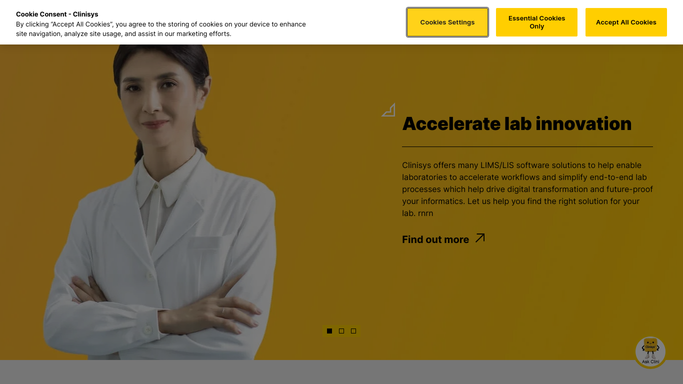
Auto verification releases the routine result without a technologist
Clinisys automates a great deal inside the lab, and it is worth exhausting all of it before adding anything around the edges.
Rules based decision support is the centre of it. A lab defines its own rules, sequences them, and lets auto verification release the results that meet every condition, so a technologist only sees what needs a person. Instrument integration goes further than a results feed: pending orders can be downloaded the moment a container is received, so the analyser knows which tests to start as the rack goes on. The industry content packages ship the workflows a water lab or a food lab already needs. And electronic laboratory reporting interfaces send reportable conditions straight to state and local public health departments.
All of that runs where an interface exists or a rule can be written.
A proficiency scheme's portal is neither. Nor is the assessing body's evidence upload, the regulator's submission site, the manufacturer's support case list, or the distributor's order tracking. Each was built for a person with a login, and no single laboratory is large enough to make them build an interface.
The quality file can build itself all year
Nothing on those sites is hard to read. It is only that somebody has to remember to go and read it, and that is where a quality manager's year goes.
Graded proficiency panels collected from each scheme's portal as they post, matched to the analyte and the instrument that produced them, so a poor score is a conversation this month rather than a finding at the next visit.
The assessing body's outstanding items read weekly, so the gap between what has been uploaded and what was asked for is visible for months instead of days. Regulator filings confirmed as accepted rather than assumed, because a submission that bounced is silent. Open cases on each instrument manufacturer's support portal listed with what the vendor last said. Reagent and control orders checked for whether they shipped, so a lot change is planned rather than discovered.
That is not integration work. A person signs in, reads what the portal shows, and records it.
In a regulated laboratory the line sits where it always sits. Gathering and comparing runs unattended. Anything touching a specimen, a result or a patient record is prepared and held for a qualified person to review and release, because releasing a result is the act the laboratory is accredited to perform.
The technologist is the scarce resource, not the analyser
An analyser will run all night. The person qualified to sign out its results will not, and spending an hour of that person on a distributor's order tracking is the worst trade in the building.
WebRun is an AI agent that works a real Chrome browser, signed in the way your staff sign in. It opens the proficiency scheme, the assessor's portal, the regulator's site or the manufacturer's support page, reads what is there, and brings it back with the dates attached.
It runs on your schedule in your own private environment, sessions are not shared between tools, and a workflow can be restricted to a named list of domains. You can watch a run and stop it part way through.
The workflows below are already built, and each one names what it opens.
Questions people ask
Is it allowed to verify or release results?
No, and it should not be. Verification and release belong to the qualified person your accreditation names. This reads outside portals and reports what it found, so the technologist spends their time on the results that need judgement rather than on a supplier's order page.
We run several lab types on one system. Does that complicate it?
Not really, because each lab type brings its own outside sites rather than its own logic. A clinical lab has proficiency schemes, a water lab has a regulator, a food lab has clients. Each workflow is pointed at the sites that lab uses and reports back separately.
Would an assessor object to us using this?
Nothing here changes a record or releases a result, so the accredited acts stay with accredited people. It gathers evidence and dates from portals your staff already log into, on a schedule you set, and you can watch a run to see exactly what it opened.
12 ready-made Clinisys workflows
Each one names the apps it touches and the exact steps it takes. Open one to read what it will do, then turn it on.

Want one of these running on your own Clinisys?
Show WebRun the process once and it will run it on schedule, in your own private browser environment.