How to Automate Cerbo
Cerbo automates the visit itself. Chart Parts, e-prescribing, parsed lab results with abnormal values highlighted, and email and text appointment reminders all run inside the chart. The work between visits, on outside lab portals, dispensary suppliers and the card processor, is still manual, and that layer suits an agent like WebRun.
 Written by
Tom Kessler
Field operations analyst
Written by
Tom Kessler
Field operations analyst
 Reviewed by
Julian Adeniyi
Retail operations
Reviewed by
Julian Adeniyi
Retail operations
Cerbo suits a practice that bills the patient, not an insurer
Cerbo is an electronic health record built for the kind of medicine that does not fit a standard chart. Functional and integrative medicine clinics use it, along with naturopaths, direct primary care practices, cash-based clinics, IV therapy and hormone replacement providers, and medical spas.
The difference that matters is who pays. A practice like this usually bills the patient or a membership rather than an insurer, which changes the whole shape of the software. There is a dispensary selling supplements. There are wellness plans that renew. There are lab panels far outside the standard set, ordered because the practitioner wanted a fuller picture rather than because a code required one.
So the chart in Cerbo is not only clinical. It is the customer record, the order history and the subscription too. The practice running it is small: one or two practitioners, one person at the front, sometimes a health coach. Nobody there has a spare afternoon.
Everything between appointments is done by hand
The visit is the easy part. It is booked, it happens, it gets charted. What fills the week is everything either side of it.
Someone logs into a specialty lab's portal to see whether a panel has come back, because that lab is not on the feed and never will be. Someone counts what is left on the dispensary shelf and works out what to reorder from the distributor's site. Someone checks which memberships renewed this month and whether the card actually went through. Someone notices, eventually, that a patient who was six months into a protocol has not booked since March.
In a practice of this size that someone is the practitioner, at nine in the evening, or the one person at the desk who is also answering the phone. Neither is doing it well, because neither has the time to.
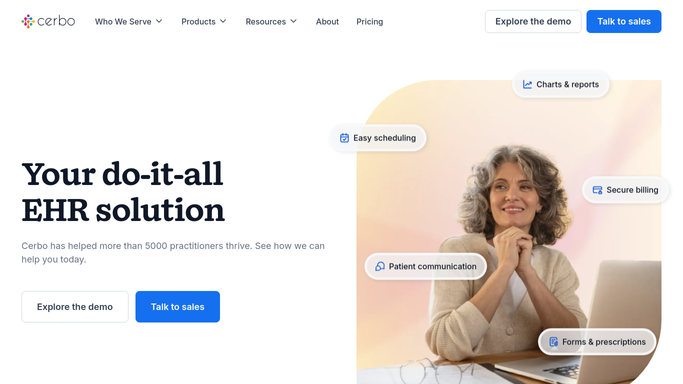
Chart Parts, lab parsing and reminders already cover the visit
Cerbo has automated the clinical hour thoroughly, and a practice that has not set all of it up is leaving the easy wins on the table.
Chart Parts, auto-complete and fillable forms for physical exams and a functional review of systems keep the note short to write. E-prescribing covers compounded and controlled medications, with renewals, medication history and a nationwide pharmacy database. Electronic lab results arrive parsed, with abnormal, high, low and critical values highlighted against their normal ranges, from more than forty standard and functional laboratories. Appointment reminders go out as an initial email, an email reminder and a text, with the wording and timing yours to set. Incoming faxes, portal messages and requests land in a task system that assigns them with due dates and pop-up reminders. The patient portal handles medication and supplement lists, results, handouts and online refill requests.
Every one of those acts on something that has already reached Cerbo: a result on the feed, a fax in the queue, an appointment in the calendar.
The lab outside those forty has a portal instead. So does the supplement distributor, the compounding pharmacy, the card processor that takes the membership payment, and the online shop the dispensary sells through. None of them push anything into the chart. Someone logs in and looks.
Results and stock arrive without anyone fetching them
Once the logging in is somebody else's problem, the practice stops running a day behind its own information.
A panel from a lab with no feed, downloaded from its portal the morning it posts and filed against the right patient, values outside range marked, so the practitioner reads it before the appointment rather than during it.
Supplement stock checked on the distributor's ordering site against what the dispensary is dispensing, so nothing is recommended that will not ship for three weeks. Memberships renewing this month lined up against what the card processor took, so a failed payment is a phone call this week rather than a discovery next quarter. The patients who finished a protocol and never came back, listed with the date of their last visit and a check-in note already written. Orders that came through the online shop matched to the chart they belong to.
None of that needs an interface, an API key or a developer. It needs a login and the patience to use it every morning.
The boundary in a clinic is firm. Collecting a result, counting stock and spotting a lapsed patient runs unattended. Reading a result, deciding a protocol and writing a prescription cannot, and anything that reaches a patient is drafted and left for a clinician.
Downloading a result is clerical work
Fetching a result and reading it are two different jobs, and only one of them needs a clinician. The fetching is the half that can be handed over.
WebRun is an agent that works a real Chrome browser, signed in as your practice is. It opens the lab portal, the distributor's site or the payment dashboard, reads what is there, and puts it where your team will see it.
It runs on your schedule in your own private environment, and a workflow can be restricted to an explicit list of sites. You can watch a run and stop it partway. Nothing clinical happens without a person, and nothing goes to a patient unread.
Each workflow below names what it opens and what it writes back.
Questions people ask
Can it order a lab or send a prescription?
No. Ordering and prescribing stay with the practitioner and stay inside Cerbo, where e-prescribing already handles compounded and controlled medications. This collects what other systems are holding, puts it in front of a person, and stops there.
Not every lab we use is on the HL7 feed. Can it still help?
That is the main reason to use it. Cerbo integrates with more than forty standard and functional laboratories, and the ones outside that list still publish to a portal of their own. An agent can log in, download the panel and file it against the right patient.
Could it share a result with a patient by mistake?
No, because it is not given that job. Releasing a result, replying in the portal and sending a recall note are all left as drafts for a clinician to review. In a practice built on the relationship, a message that lands wrong costs far more than the minutes it saved.
25 ready-made Cerbo workflows
Each one names the apps it touches and the exact steps it takes. Open one to read what it will do, then turn it on.
Want one of these running on your own Cerbo?
Show WebRun the process once and it will run it on schedule, in your own private browser environment.