How to Automate Bitwave
Bitwave automates the digital asset subledger. A rules engine categorises transactions in bulk, internal transfer detection matches both legs of your own movements, cost basis is calculated by FIFO, LIFO or specific identification, and results sync to NetSuite or QuickBooks. Gathering evidence from custodians and desks is still manual.
 Written by
Sofia Marchetti
Marketing operations
Written by
Sofia Marchetti
Marketing operations
 Reviewed by
Elliot Nakamura
Platform writer
Reviewed by
Elliot Nakamura
Platform writer
A wallet address is now a line in the general ledger
Bitwave is the back-office platform companies use to account for digital assets: the subledger, the reconciliation, the reporting and the payments for a treasury that holds crypto, not only dollars.
The companies in it are not hobbyists. Exchanges, custodians, protocol foundations, marketplaces and enterprises with a treasury allocation share one problem: a controller has to close books on assets that trade every hour of every day, across a dozen chains, held in exchange accounts, custodial wallets and multi-signature wallets nobody at the bank has heard of.
The finance team doing it is usually small and often new to the asset class.
And the evidence is public. Anybody can read the chain. An auditor will, a regulator might, and a token holder with a grievance certainly will. That makes the record closer to a published document than a private one, which is not how a general ledger usually feels.
Closing the books means explaining every transfer
The month end problem in crypto is not arithmetic. It is provenance.
Money moved between two of your own wallets looks like revenue until somebody proves both ends belong to you. A staking reward arrives with no invoice and no counterparty. A thinly traded token has no price at the timestamp the transaction happened, so a person finds one. An over-the-counter trade is confirmed by a PDF from a desk, not by anything on chain. A liquidity position accrues fees continuously and announces nothing. A bridge moves an asset and the only record is an explorer. An airdrop lands unannounced and has to be valued on the day it arrived.
So the close is somebody opening explorers, exchange statements and counterparty portals, working out what a transaction actually was, and writing down why. Then doing it again next month, for everything that arrived while they were writing.
The rules engine classifies what the connections report
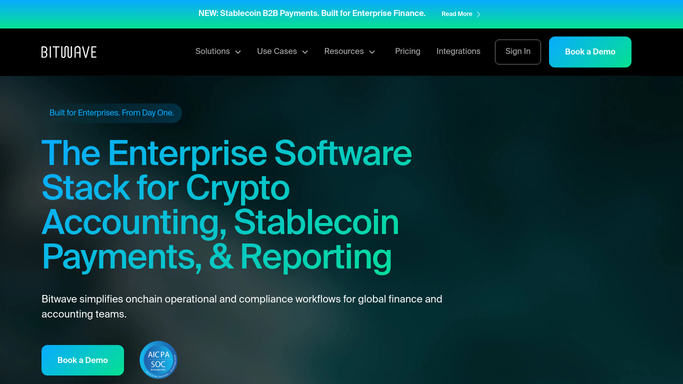
Bitwave automates most of that once the data is in front of it, and handles those parts properly.
The enterprise-grade subledger sits between the chain and the ERP, syncing to QuickBooks, NetSuite, Sage Intacct and Xero rather than asking anyone to rekey a journal. A rules engine categorises thousands of similar transactions at once and knows the difference between a trade, a transfer, a staking reward and a DeFi swap. Internal transfer detection matches the two legs of your own movements so they stop reading as income. Cost basis is calculated by the method you choose, FIFO, LIFO or specific identification, with lot-level detail behind every disposal. Impairment and fair value accounting are both supported, so carrying value is marked without a spreadsheet. Connections reach exchanges, custodians such as Fireblocks and BitGo, and DeFi protocols including Aave and Uniswap.
The ceiling is the connection list itself. Bitwave classifies what a wallet, an API or a node reports to it. A desk's trade confirmation, a price on a venue nobody indexes, the vesting schedule on a project's page, a governance vote that changed a reward rate, an exchange whose statement downloads only after a login and a code: all outside that list, and each of them changes what the entry should say.
The close can find its own gaps before the auditor does
Read Bitwave each morning and check the venues it depends on, and the close stops being a scramble in the first week of the month.
Exchange and custodian connections that failed or went stale, named with their last successful sync, so a data gap gets fixed while it is a day old. Transactions with no price for their date, listed so a manual price is supplied before anything is reported. Internal transfers with only one leg matched, surfaced before they are booked as revenue. Cost basis exceptions gathered together: zero-cost lots, missing lots, methods that disagree between wallets. Wallets added this month checked for historic transactions and a cost basis method before anything is classified.
Then the outside evidence. The custodian's balance screen compared with what the subledger says you hold. A desk's confirmation collected from its portal the day it is issued. Staking and validator statements taken from the provider's dashboard. A token unlock calendar read from the project's page, so a disposal is anticipated rather than discovered.
And the audit trail. Every transaction in the period checked for a classification, a source and an identifier, so the sample an auditor pulls is already complete.
No key is signed and no journal is posted
Which is the boundary worth stating plainly, because in digital assets it is the first thing anybody asks. An agent that reads is a different animal from one that holds keys, and this one never does.
WebRun works a real Chrome browser, signed in as you. It opens Bitwave the way your accounting team does, reads the wallets, the classifications, the exceptions and the sync status, then opens the custodian, the exchange or the desk portal beside it and brings back what disagrees.
No transaction is broadcast, no asset moves, no disposal is booked and no journal reaches your ERP without a person approving it. What it produces is a list, a comparison or a draft.
The workflows below are already built, and each one names what it opens.
Questions people ask
Can it move assets or sign a transaction?
No, and it holds no keys. It reads screens and reports what it finds. Broadcasting a transaction, moving an asset, booking a disposal and posting a journal all stay with your accounting and treasury teams.
Is it safe to let it sign into an exchange account?
The session lives in your own private environment and is not shared with the other tools in a workflow, and a run can be locked to an explicit list of domains. Use a read-only account wherever the venue offers one.
Will it change classifications inside Bitwave?
Not on its own. It builds the exception list and prepares what it found. Applying a classification or a manual price stays a deliberate act by the person responsible for the books.
12 ready-made Bitwave workflows
Each one names the apps it touches and the exact steps it takes. Open one to read what it will do, then turn it on.


Want one of these running on your own Bitwave?
Show WebRun the process once and it will run it on schedule, in your own private browser environment.