How to Automate Zoobook Systems
Zoobook covers the opioid treatment program itself. Easy Dose Tracking records the dose, Take-Home Management carries the documentation, Smart Alerts flag a missed dose, and Reports in One Click sends data to authorities. Monitoring programs, guest dosing between clinics and payer portals sit outside it, and WebRun reads those.
 Written by
Julian Adeniyi
Retail operations
Written by
Julian Adeniyi
Retail operations
 Reviewed by
Ben Kirkwood
Solutions engineer
Reviewed by
Ben Kirkwood
Solutions engineer
Zoobook was built by somebody who ran the facility
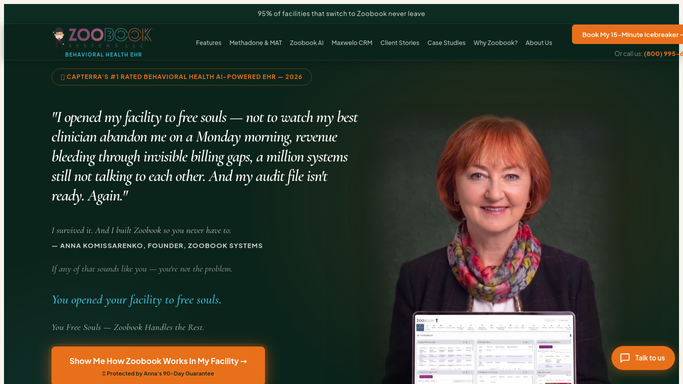
Zoobook is an electronic health record for behavioral health, mental health and addiction treatment, and it was built by an owner of facilities in that field rather than by a software company that decided to enter it. That shows in what it chooses to be good at. It is ONC Certified Health IT, and it runs outpatient programs, residential treatment centres, mental health agencies, court-mandated programs and multi-site networks.
The part of the market that shapes the product most is the opioid treatment program: methadone clinics and medication-assisted treatment. Very little else in healthcare works this way. A patient attends daily, in person, and receives a controlled substance dispensed on site under federal rules, in a window that is often over before most offices have opened.
So the software cannot be only a clinical record. It is a clinical record, a dispensary log and a compliance file at once, and the same screen has to satisfy a counsellor, a nurse and an inspector.
An opioid treatment program answers to more agencies than it employs staff
Dosing people and counselling them is what the clinic does. Proving it to somebody else is what fills the administrative day.
Take-home eligibility is decided against federal criteria and revisited as a patient's circumstances change, which means somebody has to notice when a review has fallen due. A prescription monitoring program has to be checked, and in most states that is a separate login with its own password rules. A patient travelling next week needs a guest dose arranged with another program, negotiated by telephone or fax between two clinics running different software. Confirmatory screens come back from a laboratory. A managed care organisation authorises the counselling and expects to be asked again. And a state reporting deadline arrives whether or not anyone has assembled the numbers.
The dose, the note and the claim are already one record
None of this is a gap Zoobook has ignored, and the dosing side in particular is well covered.
Easy Dose Tracking records doses as they are given and works with both manual pumps and automated dispensing systems. Take-Home Management carries the take-home documentation. Smart Alerts notify staff when a dose is missed or a follow-up is needed. Compliance Built In puts SAMHSA and DEA requirements into the system itself rather than into a binder, and Reports in One Click sends data to authorities without a week of manual compilation. Zoobook AI drafts BIRP, SOAP and DAP notes from session content. Around those sit bi-directional lab interfaces, ePrescribe, automated billing and claims, scheduling and bed management, state database integration including NJSAMS, and Maxwelo CRM.
Those integrations are real, and where a state database or a laboratory is wired in, that particular problem is finished. The difficulty is that neither list is ever complete. A program operating in more than one state finds one integration and one website. The monitoring program is usually a separate login regardless. The other opioid treatment program across the state line, arranging next week's guest dose, runs its own system and has no interest in yours. The managed care organisation has a portal, and the referring court has a clerk.
Every outside system checked before the first patient doses
Once those outside systems can be opened on a schedule, the clinic stops learning about its own obligations late.
The monitoring program checked for every patient whose review falls due this week, so a query that has to happen has happened before the counsellor sits down. Take-home eligibility gathered ahead of the decision: everyone whose time in treatment, attendance and screen history mean a review is owed, listed for the clinical team rather than surfacing when somebody remembers.
Guest dosing requests read from wherever they actually land, the fax inbox, the shared email account, the other program's portal, so a request made on Thursday is settled before the patient travels. Confirmatory results collected from the laboratory that is not on the interface and matched to the right chart. Managed care authorisations sorted by which expires first. State reporting figures assembled in the format that state asks for, with the working shown, ready for the person whose name goes on it.
This is about as regulated as software gets, and the line sits accordingly. Reading, comparing, assembling and flagging can all run unattended. Anything that alters a chart, records a dose, files a report with a state or federal authority, or reaches a patient, is prepared and then waits for a qualified person.
Compliance is mostly a reading problem
Almost none of that is clinical judgement. It is one person opening eight sites in a fixed order and copying across what they find, usually while a queue is already forming at the dosing window.
WebRun is an AI agent that drives a real Chrome browser, signed in as your own staff are, inside a private environment of your own. Sessions are not shared between tools, and a workflow can be locked to an explicit list of domains, so it reaches the monitoring program and the payer sites you named and nothing else. You can watch a run and stop it partway.
It reads and it prepares. No dose is recorded, no chart is altered, no report is filed, and nothing reaches a patient until a qualified person has approved it.
Every workflow below states which system it opens.
Questions people ask
Would it record a dose or change a dosing order?
No, and that is the clearest line in the product. Dosing is a controlled act carried out by licensed staff at the window. It reads what has already been recorded and flags anything that looks inconsistent, but it never writes a dose, a change or an order.
Can it submit our state report for us?
No. It assembles the figures in the format the state asks for and attaches the detail behind them, then a qualified person checks and files. Filing with a state or federal authority is a signature nobody should hand to software.
We run programs in three states. Does that mean three setups?
No. One workflow can work several state systems in turn, because it signs in to each the way your staff do rather than waiting for an integration to exist. Where Zoobook already has a state database integration, use that; this covers the states it does not reach.
12 ready-made Zoobook Systems workflows
Each one names the apps it touches and the exact steps it takes. Open one to read what it will do, then turn it on.

Want one of these running on your own Zoobook Systems?
Show WebRun the process once and it will run it on schedule, in your own private browser environment.