
Somewhere in every wound care clinic there is a list of authorizations. A spreadsheet, a tab in the practice management system, sometimes a printed sheet in a folder. Each line has a patient, a payer, an authorization number, an end date and a number of visits left on it, and on the day it was typed it was correct.
Then a week happens. Four patients get added to Thursday, two people are out, a payer changes what it will accept, and the list goes four days without being opened. Nothing announces that. The authorization that ran out on the 14th does not message anybody. It turns up three weeks later as a denial, on a visit that was delivered, documented and billed.
The American Medical Association put a number on the general version of this. In its 2025 Prior Authorization Physician Survey, released on 13 May 2026, physicians reported completing an average of 40 prior authorizations a week, taking about 13 hours of physician and staff time. Two in five said they employ staff who do nothing else. Those figures cover every specialty rather than wound care alone, but the shape is familiar. The work is constant, it is clerical, and it loses every contest for attention against a patient who is in the room.
Why an authorization goes past its date
Wound care is harder to track than a one-off approval, because an authorization here usually carries two limits instead of one. There is a date range, and there is a number of visits. Either can run out first. A patient halfway through a plan of care can sit comfortably inside the date range with no visits left, or have four visits left on an authorization that expired on Sunday.
A wound care billing guide published by Blue Peak RCM on 30 September 2026 puts the requirement in a single line: a well run practice "tracks authorization limits by visit count and date range". That is easy to agree with and hard to do, because doing it means somebody opens the list every working day, not on the days they remember to.
It is not a problem the payers are about to take off your hands either. CMS published the Interoperability and Prior Authorization final rule, CMS-0057-F, which requires affected payers to run prior authorization APIs, and its API deadline is primarily 1 January 2027. Until those exist, and until the software you use reads them, the live status of an authorization sits on a screen that a person has to open.
What runs every morning instead
The authorizations sit in your wound care record system behind one login, the tracker is in Airtable behind another, and the billing team reads Slack. Nobody is going to commission an integration between those three to produce a daily list. An agent can sign in the way your staff do, read what they would read, and write it where they would write it.
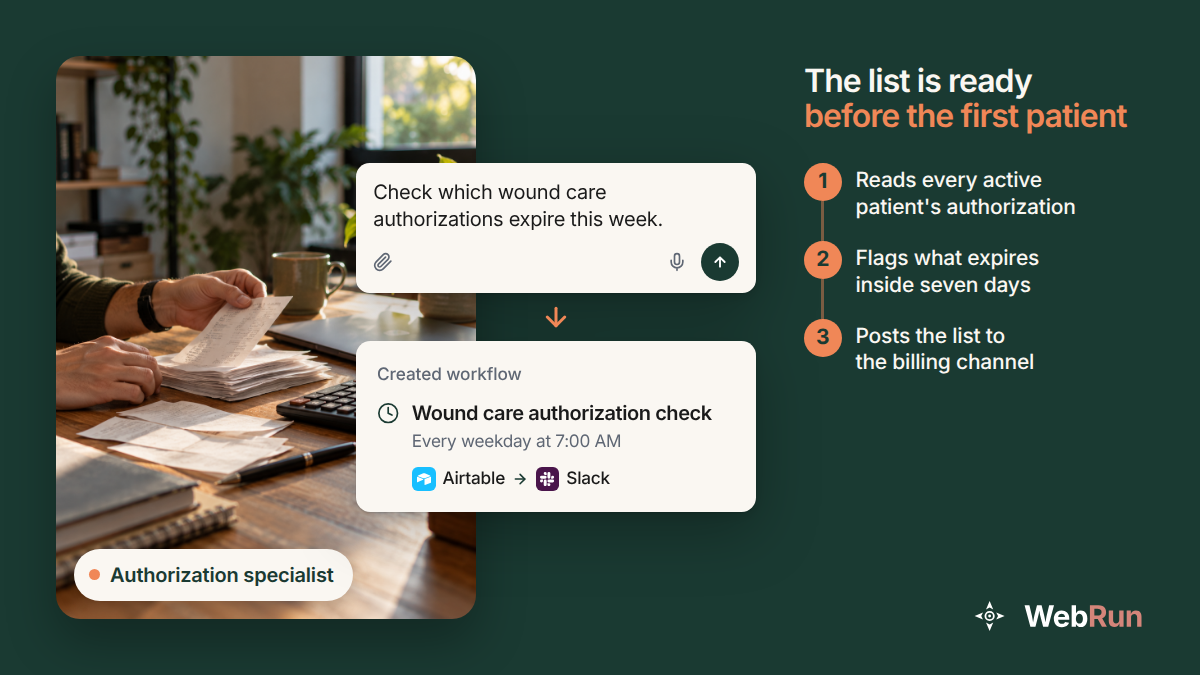
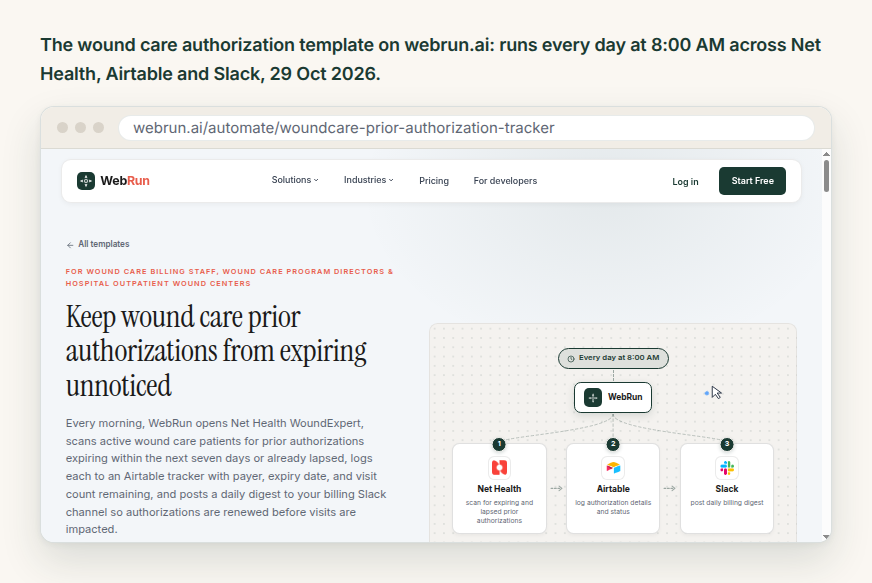
The wound care prior authorization template is that run, already put together. On every weekday morning it does this:
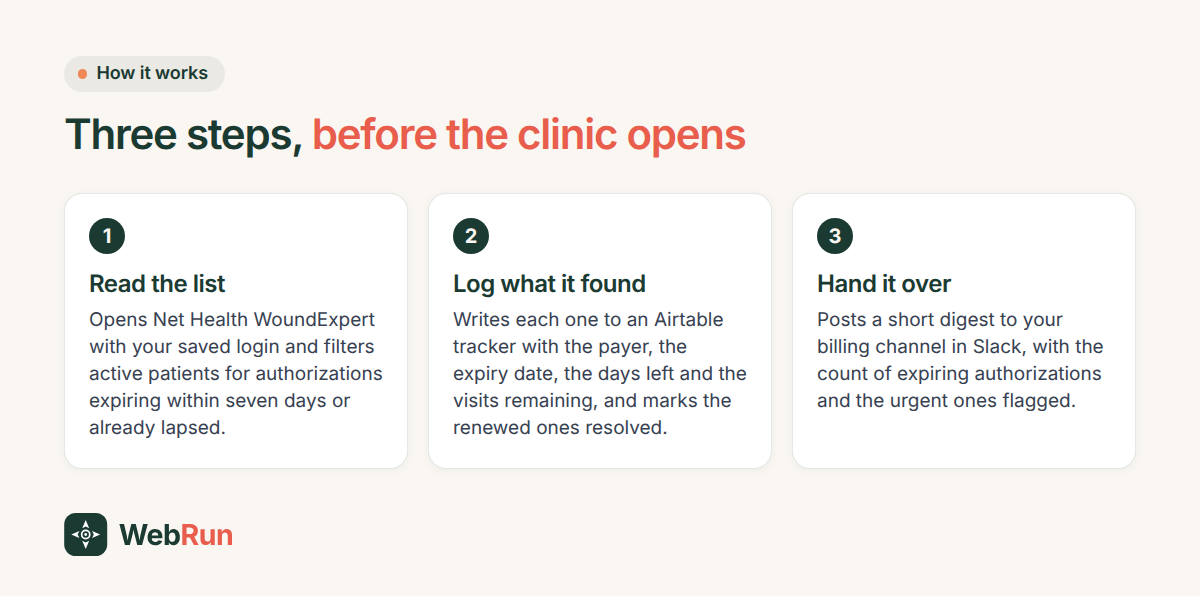
- Opens Net Health WoundExpert with your saved login and goes to the authorization management section.
- Filters active wound care patients for authorizations expiring within the next seven days, and also catches the ones that have already lapsed while the patient is still on the schedule.
- Records the patient, the payer, the authorization number, the expiry date and the number of authorized visits remaining.
- Writes all of it into an Airtable tracker, updates the rows whose status has changed, and marks anything renewed since the last run as resolved.
- Posts a digest to your billing channel in Slack: how many are expiring, which ones are urgent, and a link to the tracker.
Net Health says WoundExpert is used by more than 20,000 clinicians, so most wound care programmes will recognise the first step. If yours runs on something else, the run keeps its shape and changes its first screen. The agent works the web interface rather than an API, so what it needs is a login and a page that lists the authorizations.
What you set up, and where
Start with the logins. The agent works inside its own browser environment, signed in to the systems you point it at. If you bill for more than one clinic, give each one its own environment, so one site's credentials and history never sit beside another's.
Then pick the hour. Seven in the morning works well: the digest is waiting when the billing staff sit down, and a renewal started at 7:15 still has a whole day to reach somebody at the payer.
The rules come last. You say where the agent may go and what it may never touch. This run only reads and records, so nothing is submitted to a payer on anybody's behalf. It keeps a recording of every run, so when a line in the digest looks wrong you can go back and see the screen it came from.
What it looks like after a month
Nothing dramatic happens on day one. The first digest is usually longer than anyone expects, because it includes the lapsed authorizations nobody had got to yet, and working through that backlog is a week of real effort.
What changes is when you find out. An expiry that used to appear as a denial three weeks after the visit now appears as a line in a Slack message seven days before it. The work of renewing is the same work. It moves to the side of the visit where it is still cheap, and where the patient is not the one absorbing the delay. The AMA's survey found that 95% of physicians say prior authorization delays access to care, and the delay is the part a patient actually feels.
The tracker also stops being somebody's private list. Because the same run writes it every morning, anyone can open it and see where things stand without asking the person who owns the spreadsheet.
Where this does not help
It does not file the authorization. Submitting a renewal, arguing a denial and sitting on hold with a payer are still human work, and payers that take requests only by phone or by fax stay exactly as annoying as they were.
It does not know when a payer's policy changes. If a plan cuts the number of visits it will authorize, the agent reports the new number without marking it as a change. Somebody still has to read the payer bulletins.
And it inherits whatever is in your record system. If an authorization was entered with the wrong end date, the digest will be wrong in the same way, a day earlier.
Try it on one clinic first
Take one site, one record system and one Slack channel, and run it for two weeks. Read the digest each morning and compare it against what the billing team already knew. That comparison is what tells you whether it is reading your system correctly, and it costs about ten minutes a day.
The quickest way to start is to describe the job in a chat and watch the first run happen, then put it on a schedule once the output looks right. If you would rather start from something already written, the template library has the authorization tracker and thousands of other ready made workflows, including the one that chases overdue invoices on a Monday morning.